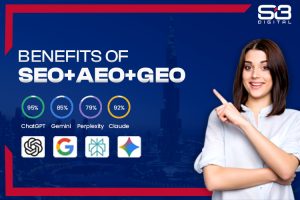
These days SEO, AEO, and GEO is the new ways customer discover businesses online. Traditional Google searches now coexist with AI-generated answers, conversational search and platforms that help users research products, compare services and evaluate businesses. For companies in Dubai and across the UAE, understanding these changes is becoming an important part of digital marketing planning.
Search Engine Optimization (SEO), Answer Engine Optimization (AEO) and Generative Engine Optimization (GEO) address different aspects of online discoverability. Although their methods overlap, each offers a useful perspective on how businesses can make their information easier to find, understand and trust.
But does your business need all three? Can SEO still deliver results in 2027? How can you improve your visibility in AI-generated answers, and how do you know whether these efforts are generating qualified leads?
At Si3 Digital, we believe the answer starts with a strong SEO foundation, useful and authoritative content, and a measurement approach that connects search visibility with business results.
In this guide, we explore the benefits of SEO AEO GEO in 2027, explain how they work together, and share practical steps UAE businesses can take to prepare for the changing search landscape.

What Are the benefits of SEO AEO GEO?
SEO, AEO and GEO are connected approaches to improving how people discover information about your business online. Understanding their differences helps you invest in the activities that support your business goals.
1. What Is Search Engine Optimization (SEO)?
Search Engine Optimization (SEO) is the process of improving a website’s visibility in organic search results by making its pages accessible, relevant, useful and understandable to search engines and users.
SEO combines technical improvements, content optimization, keyword research, internal linking, website performance and the development of credible online references.
For example, a Dubai-based web development company may optimize its service pages for searches such as “website development company in Dubai” or “eCommerce website development UAE”. It can also publish useful guides about website costs, platform selection and website maintenance.
When these pages address relevant search intent and meet search-engine requirements, they have an opportunity to attract people actively researching those services.
Key benefits of SEO include:
- Improving organic visibility for relevant searches.
- Attracting visitors who are actively researching products or services.
- Strengthening website structure and content quality.
- Supporting local discovery through relevant location and business information.
- Building long-term opportunities for organic traffic and qualified enquiries.
SEO remains an essential foundation for online visibility. Google’s official guidance confirms that its established SEO practices remain relevant to AI-powered search experiences, including AI Overviews and AI Mode.
However, SEO does not guarantee rankings, traffic or sales. Results depend on competition, search intent, website quality and other factors.
2. What Is Answer Engine Optimisation (AEO)?
Answer Engine Optimisation (AEO) focuses on making information clear, direct and useful for systems that respond to users’ questions.
Rather than concentrating only on broad search terms, AEO considers the specific questions customers ask before making a decision.
For example, someone searching for digital marketing services may ask:
- How much does digital marketing cost in Dubai?
- What is the difference between SEO and Google Ads?
- How long does SEO take to produce results?
- What should I look for when choosing an SEO company?
A website that answers these questions clearly can provide a better experience for potential customers and help search systems understand the information.
AEO may involve question-based headings, concise explanations, descriptive page structures, relevant examples and accurate supporting information.
It is important to understand that AEO is an industry term rather than a separate Google ranking system with a guaranteed set of optimization requirements.
Key benefits of AEO include:
- Making answers easier for users to find and understand.
- Addressing common customer questions and objections.
- Supporting informational and commercial search intent.
- Improving the usefulness of service pages and educational content.
- Creating opportunities to be considered for relevant answer-focused search experiences.
The objective is not simply to produce shorter answers. It is to provide accurate, complete and useful information in a format that serves the reader.
3. What Is Generative Engine Optimization (GEO)?
Generative Engine Optimization (GEO) focuses on improving a brand’s visibility and representation in AI-generated responses.
Generative AI tools can help users explore a topic, compare businesses, understand services and discover potential providers. Depending on the platform and query, their responses may include links or citations to external websites.
For example, a business owner might ask an AI assistant:
“What should a small business in Dubai consider when choosing a digital marketing agency?”
The answer may discuss relevant services, evaluation criteria and potential providers. A company with useful, accurate and well-supported information may have an opportunity to be referenced, but inclusion is never guaranteed.
GEO can involve strengthening website content, publishing original research, demonstrating genuine expertise, maintaining accurate business information and earning credible references from relevant sources.
These activities overlap considerably with established SEO and content marketing practices. There is no universal GEO formula that guarantees inclusion across different AI platforms.
Key benefits of GEO include:
- Monitoring how AI platforms represent your business.
- Identifying opportunities to improve the information available about your brand.
- Strengthening the evidence supporting your services and expertise.
- Understanding whether your website is cited in relevant AI-generated responses.
- Exploring additional discovery opportunities beyond traditional search results.
GEO should be treated as an extension of a wider digital visibility strategy, not a replacement for SEO.
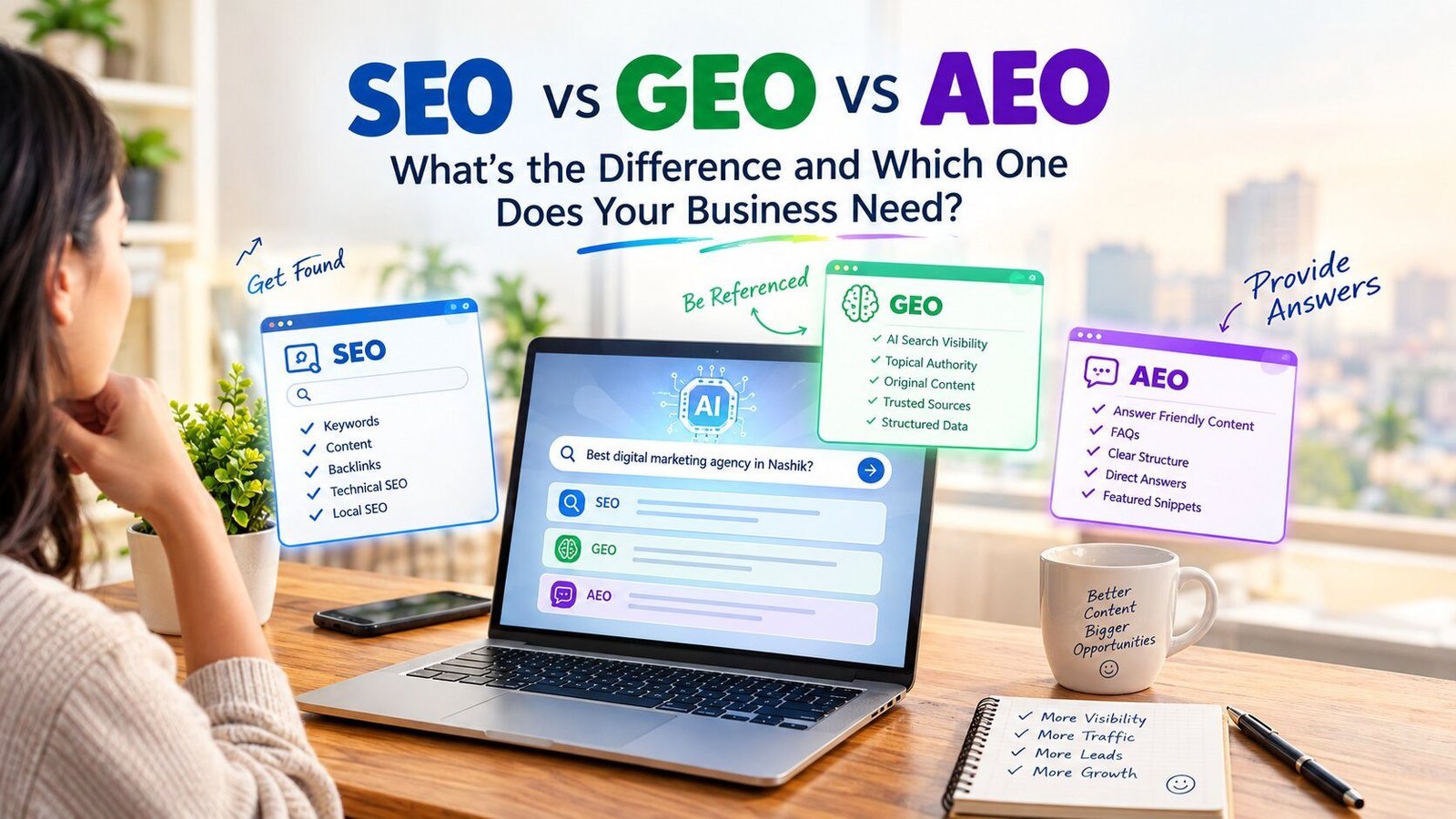
SEO vs AEO vs GEO: What Is the Difference?
Although these approaches share several activities, their primary objectives differ.
| Comparison | SEO | AEO | GEO |
|---|---|---|---|
| Primary objective | Improve organic search visibility | Make information useful for question-based answers | Improve visibility in generative AI responses |
| Main focus | Search relevance, technical accessibility, content and authority | Clear answers, question intent and information structure | Brand representation, useful content, evidence and AI citations |
| Typical activities | Keyword research, technical SEO, content optimization and internal linking | Question-based content, concise answers and clear headings | Original research, expert content, brand mentions and citation monitoring |
| Potential discovery channels | Traditional organic search and relevant search features | Answer-focused search experiences and conversational interfaces | AI-generated responses and supported citation experiences |
| Measurement | Impressions, clicks, rankings and organic conversions | Relevant answer visibility where measurable, plus engagement and conversions | Brand mentions, citations, referral visits and attributable conversions |
| Business objective | Attract relevant organic visitors | Help users find useful answers | Understand and improve discoverability in generative AI experiences |
The key takeaway: SEO establishes the foundation, AEO helps communicate answers clearly, and GEO focuses on how your brand appears in generative AI experiences.
These are overlapping disciplines rather than three completely separate systems. A well-structured, technically sound website with useful content can support all three.
What Are the Benefits of SEO AEO GEO in 2027?
The benefits depend on your industry, target audience, competition and the quality of your digital marketing strategy. However, integrating these approaches can help businesses address several important visibility and growth objectives.
1. Improve Visibility Across Search Experiences
Customers may discover your business through conventional search results, local listings, question-based queries or AI-generated responses.
Optimising your website for relevant searches while providing clear, reliable information helps you prepare for these different discovery experiences.
For a Dubai-based service provider, this could mean improving service pages, publishing answers to common buyer questions and monitoring whether relevant AI platforms reference the company.
The goal is not to appear everywhere. It is to improve your chances of being discovered in the places that matter to your potential customers.
2. Attract More Relevant Website Visitors
Website traffic is valuable when it comes from people who have a genuine interest in your services.
SEO can help connect your pages with relevant searches, while AEO-informed content can address questions that arise during the buying process. GEO monitoring can help identify whether AI-generated answers are creating additional discovery opportunities.
For example, a person searching for “website design cost in Dubai” may be researching prices, while someone searching for “eCommerce website development company in Dubai” may be closer to selecting a provider.
Understanding these differences helps you create content that matches the needs of potential customers at different stages of their decision-making process.
However, better visibility does not automatically mean more qualified traffic. Search intent and the relevance of the page remain important.
3. Build Trust Through Useful, Verifiable Content
Customers need more than service descriptions before deciding which company to contact.
They may want to understand your experience, compare your approach with competitors, review your work and assess whether your claims are credible.
Businesses can strengthen their content by providing:
- Genuine project examples and case studies.
- Clear explanations of services and processes.
- Accurate information about pricing and deliverables.
- Relevant credentials and professional experience.
- Original insights supported by evidence.
- Consistent and accurate company information.
Google’s people-first content guidance emphasises creating useful information for people rather than producing content solely to attract search traffic.
This principle is relevant to SEO and to any strategy intended to improve how customers and AI systems understand your business.
4. Support Local SEO and Business Discovery in Dubai
For businesses serving Dubai and the wider UAE, local relevance can play an important role in attracting customers.
A local SEO strategy may include optimizing relevant service pages, maintaining an accurate Google Business Profile, collecting genuine customer reviews and ensuring business information is consistent across important platforms.
For example, a company offering website development in Dubai may need a clear service page explaining its capabilities, industries served, project process and service area.
A business targeting customers across several Emirates should communicate its actual coverage accurately rather than creating misleading location pages.
Local SEO remains important regardless of whether customers begin their research through traditional search or use AI tools to explore potential providers.
5. Understand Your Brand’s Visibility in AI-Generated Answers
Traditional search performance reports do not provide a complete picture of how your business appears across every AI platform.
GEO monitoring can help you investigate questions such as:
- Does the AI platform mention our company for relevant service queries?
- Does it cite our website or refer to other sources?
- Is the information about our services accurate?
- Which competitors appear in comparable responses?
- Are there gaps in the information available about our business?
- Does AI-referred traffic generate enquiries?
These questions help turn AI visibility from a vague marketing concept into something you can investigate and measure.
Importantly, an AI mention is not the same as a website citation, and neither necessarily produces a qualified lead.
6. Improve Opportunities for Qualified Lead Generation
Visibility is only one part of a successful digital marketing strategy.
Once potential customers discover your business, they need a reason to trust you and a straightforward way to take the next step.
That means your website should include clear service information, useful supporting content, relevant proof of experience and accessible enquiry options.
For example, a B2B company may benefit from detailed service pages, industry-specific case studies and a clear meeting-booking process.
A consumer-facing e-commerce business may instead prioritize product information, category navigation, purchasing information and a smooth checkout experience.
SEO, AEO and GEO can support discovery, but lead generation also depends on the quality of your offer, the customer experience and the effectiveness of your conversion process.
7. Make Better Digital Marketing Investment Decisions
Not every business needs to invest equally in every activity.
A website with technical problems may benefit more from fixing crawlability, indexability and important page errors than from launching a new GEO campaign.
A business with strong organic visibility but limited commercial content may need better service pages and clearer answers to buyer questions.
A company that already performs well in traditional search may choose to investigate how often it appears in relevant AI-generated responses.
The right approach depends on the current situation.
The objective is to invest in the activities most likely to address your business’s actual visibility and conversion gaps, rather than purchasing services simply because they have a new name.
How Can UAE Businesses Prepare for SEO, AEO and GEO in 2027?
Preparing for the changing search landscape starts with improving the fundamentals and then building a measurement process.
Here are seven practical steps businesses can take.
Step 1: Audit Your Existing Website
Begin by checking whether search engines can access and index your important pages.
Review technical issues, internal links, mobile usability, page performance and any errors affecting important service or product pages.
Check whether the website clearly communicates your services, target audience, locations and business information.
Technical accessibility does not guarantee rankings, but unresolved technical problems can undermine the effectiveness of your content and SEO activities.
Step 2: Understand Your Customers’ Search Intent
Identify the questions potential customers ask before choosing your products or services.
These questions may relate to costs, benefits, comparisons, timelines, technical requirements, risks or expected outcomes.
For example, a Dubai business considering SEO services might want to know:
- How much does SEO cost in Dubai?
- What should an SEO package include?
- How can I measure SEO performance?
- When should I expect to see improvements?
- How do I evaluate an SEO agency?
Use genuine customer enquiries, sales conversations, keyword research and website analytics to prioritise the topics.
Do not assume that a question is popular simply because it sounds useful. Validate demand where possible.
Step 3: Create Helpful, Answer-Focused Content
Develop pages and articles that answer relevant questions accurately and comprehensively.
Use descriptive headings, concise explanations, meaningful examples and supporting evidence.
For complex topics, explain the reasoning behind your recommendations rather than providing a short answer without context.
A useful page about digital marketing costs, for instance, should explain what influences pricing, which services may be included, what can increase the cost and whether advertising expenditure is separate from management fees.
This approach serves readers while creating content that search systems can interpret more easily.
Step 4: Demonstrate Genuine Expertise
Avoid relying entirely on generic descriptions that could apply to any company.
Where appropriate, publish original research, explain your working methods, provide genuine case studies and support factual claims with reliable sources.
If you report an improvement in organic traffic or lead generation, state the measurement period and explain how the result was measured.
Do not invent performance figures, customer testimonials, credentials or case-study results.
Original, verifiable information gives potential customers a stronger basis for evaluating your business.
Step 5: Use Structured Data Correctly
Structured data can help search engines interpret information about a page or business and may make a page eligible for supported search features.
Depending on the website, relevant types may include Organization, Local Business, Article, Product and Breadcrumb List.
Choose markup that accurately describes the visible content and follows the applicable search-engine guidelines.
However, structured data is not a guaranteed ranking factor, an automatic AI citation mechanism or a requirement for appearing in Google AI Overviews or AI Mode.
Implement it for valid purposes, validate it and assess the actual results.
Step 6: Monitor AI Search Visibility
Choose a defined set of questions that matter to your business and test them across selected AI platforms.
Record whether your brand is mentioned, whether your website is cited, which competitors appear and whether the information is accurate.
Repeat the tests under consistent conditions and report each platform separately.
AI responses can vary between prompts, sessions, locations and dates. A small sample should not be presented as a complete measure of your market visibility.
Over time, this process can help identify patterns and opportunities for improving your content and business information.
Step 7: Connect Visibility With Business Results
Use your analytics and CRM data to understand what happens after people discover your business.
Track relevant website visits, enquiry submissions, booked meetings, qualified leads and sales opportunities.
Where possible, distinguish organic search traffic from identifiable AI-platform referrals and other acquisition channels.
Review not only the number of enquiries but also their relevance, conversion rate and commercial value.
This helps you understand whether your marketing efforts are contributing to business objectives rather than simply increasing visibility metrics.
How Do You Measure SEO, AEO and GEO Performance?
One of the biggest mistakes businesses can make is treating every visibility metric as evidence of business growth.
A useful measurement framework separates search performance, AI visibility, website engagement and commercial outcomes.
| Measurement area | What to measure | Suitable approach |
|---|---|---|
| SEO performance | Impressions, clicks, click-through rate and relevant query performance | Google Search Console |
| Website engagement | Landing-page performance, engagement and conversions | Google Analytics or another suitable analytics platform |
| AEO-related visibility | Whether relevant answers or search features display your content, where measurable | Search-result monitoring and documented testing |
| GEO performance | Brand mentions, website citations and answer accuracy | Repeatable AI-platform tests or suitable monitoring tools |
| Referral traffic | Visits attributed to identifiable AI-platform referrals | Analytics and referral reports |
| Lead generation | Enquiries, qualified leads and booked meetings | Website conversion tracking and CRM |
| Commercial outcomes | Sales opportunities, acquisition costs and attributed revenue | CRM and financial reporting |
Google’s documentation explains that activity from AI Overviews and AI Mode is included in the overall Web search performance reporting in Search Console.
This does not mean Search Console measures every mention or citation across external AI platforms. Businesses need separate methods for assessing visibility elsewhere.
An illustrative AI Citation Coverage Rate
To make AI visibility easier to monitor, Si3 Digital can use an internal measurement framework called the AI Citation Coverage Rate.
The formula is:
AI Citation Coverage Rate = Test responses citing your website ÷ Total eligible test responses × 100
For example, suppose a company tests 60 relevant prompts on a selected AI platform and its website is cited in 18 eligible responses.
Its AI Citation Coverage Rate would be:
18 ÷ 60 × 100 = 30%
This is an illustrative result, not an industry benchmark or an official Google metric.
For a meaningful comparison, define what counts as an eligible response, count citations consistently, document the prompts and testing dates, and report results separately for each platform.
You can then repeat the test over time to investigate changes in visibility.
Most importantly, measure citations separately from website traffic, qualified enquiries and revenue. A higher citation rate does not automatically mean better business performance.
Common SEO, AEO and GEO Myths Businesses Should Avoid
As interest in AI search grows, businesses may encounter claims that exaggerate what optimization can achieve.
Understanding the limitations can help you make better decisions.
Myth 1: SEO Will Become Irrelevant in 2027
Reality: Google’s current guidance confirms that established SEO practices remain relevant to its AI-powered search experiences.
The search landscape may evolve, but technical accessibility, useful content and relevance remain important foundations.
Businesses should adapt their measurement and content strategies rather than abandon SEO.
Myth 2: GEO Guarantees Mentions in ChatGPT or Other AI Platforms
Reality: No general optimization method guarantees that an AI platform will mention or cite a particular business.
Visibility depends on the platform, query, available information and other factors that may change.
Choose agencies that explain their methodology and measurement process rather than promising guaranteed citations.
Myth 3: Adding Schema Automatically Improves AI Rankings
Reality: Structured data has supported uses, but Google does not require special schema markup for AI Overviews or AI Mode.
Implement accurate markup where appropriate, but do not treat it as a shortcut to AI visibility.
Myth 4: Publishing More AI-Generated Articles Guarantees Better Rankings
Reality: Content volume alone does not establish quality, originality or usefulness.
Google’s spam policies address scaled content abuse when large volumes of content are produced primarily to manipulate search rankings rather than help users.
AI tools can support research and writing, but content should be reviewed for accuracy, relevance and original value.
Myth 5: More AI Mentions Automatically Mean More Sales
Reality: A brand mention may increase awareness without generating a website visit or an enquiry.
Measure the full journey where possible, from discovery to engagement, qualified lead and sale.
Myth 6: Every Business Needs Separate SEO, AEO and GEO Campaigns
Reality: The activities overlap substantially.
Many improvements to technical SEO, content quality, business information and website structure can support multiple discovery experiences.
The right mix depends on your existing visibility, audience, competition and objectives.
How Can Si3 Digital Help Your Business Prepare for Search in 2027?
Preparing for the next stage of search requires more than chasing individual rankings or experimenting with AI tools.
Businesses need a connected digital marketing approach that improves discoverability, communicates value, builds credibility and turns relevant visitors into enquiries.
At Si3 Digital, we help businesses strengthen their online presence through services that include:
- Search Engine Optimization: Technical SEO, on-page optimization, content improvements and relevant organic search visibility.
- Local SEO: Business Profile optimization, location relevance and local search visibility.
- Content Optimization: Useful service pages, educational articles and question-focused content aligned with customer needs.
- Website Design and Development: Websites built around usability, technical accessibility and business objectives.
- Google Ads Management: Paid search campaigns designed to reach relevant audiences and support measurable marketing goals.
- AI Visibility Monitoring: Structured testing of brand mentions and website citations across selected AI search experiences, where suitable tools and methods are available.
- Conversion Optimization: Improvements to landing pages, enquiry journeys and calls to action to support lead generation.
Our approach is to identify your business’s current gaps, prioritize meaningful improvements and establish measurement that reflects your goals.
Not every business requires the same combination of services. Some need to resolve technical SEO problems first, while others may benefit from stronger content, better conversion paths or additional AI visibility monitoring.
The priority is to develop a strategy around your business, not simply follow the latest marketing trend.
Is your website ready for the changing search landscape? Si3 Digital can help you evaluate your current online visibility and identify practical opportunities to strengthen your search performance and digital lead generation.
Frequently Asked Questions About SEO, AEO and GEO in 2027
1. What is the difference between SEO, AEO and GEO?
SEO focuses on improving organic search visibility. AEO focuses on presenting useful, direct answers to relevant questions. GEO focuses on improving a brand’s visibility in generative AI responses.
Their activities overlap, and a well-optimized website can support all three.
2. Is SEO still important in 2027?
Yes. Google’s current guidance confirms that established SEO practices remain relevant to its AI-powered search experiences. Businesses should continue improving technical accessibility, content quality, relevance and website usability while adapting their measurement to changing discovery channels.
Future search developments cannot be predicted with certainty, but abandoning SEO is not a sound response to the growth of AI search.
3. Can a website rank on Google without appearing in AI answers?
Yes. Traditional organic rankings do not guarantee inclusion in an AI-generated answer.
Different search experiences may select and present information differently. Businesses should monitor conventional search performance and AI visibility separately.
4. Does GEO help businesses generate leads?
GEO aims to improve a brand’s visibility in generative AI experiences, but visibility does not automatically produce leads.
The commercial impact depends on factors such as customer intent, the relevance of the information, website experience and the business’s ability to convert enquiries.
Businesses should measure AI mentions and citations alongside referral traffic, qualified leads and sales outcomes.
5. Is schema markup required for AI search visibility?
No special schema markup is required to appear in Google AI Overviews or AI Mode.
Structured data remains useful for supported search features when it accurately represents page content and follows applicable guidelines. However, implementing schema does not guarantee rankings, rich results or AI citations.
6. How can I check whether ChatGPT or other AI platforms mention my business?
Create a list of relevant questions about your services, location and industry. Test those prompts on selected AI platforms and record whether your brand appears, whether your website is cited and whether the information is accurate.
Repeat the process under consistent conditions. Because responses can vary, treat the results as a monitoring sample rather than a definitive measure of all AI visibility.
7. How long does SEO take to produce results?
SEO timelines vary according to website condition, competition, content quality, the work required and other market factors.
Some improvements may be reflected relatively quickly, while meaningful organic growth can take months or longer. There is no universal timeline that guarantees a particular ranking or volume of leads.
8. Should small businesses in Dubai invest in SEO, AEO and GEO?
Small businesses should prioritize the activities most relevant to their customers and current visibility gaps.
A sound starting point is usually technical SEO, useful service pages, accurate business information and a clear conversion process. Businesses can then assess whether answer-focused content and AI visibility monitoring would provide additional value.
A separate campaign for every discipline is not always necessary.
9. Can AI-generated content help with SEO?
AI can support research, outlining, editing and content production. However, content should be accurate, useful, relevant and reviewed appropriately.
Producing large volumes of generic or unoriginal content primarily to manipulate search rankings can create risks. Original expertise, reliable evidence and genuine value remain important.
10. How much does SEO cost in Dubai?
SEO costs in Dubai depend on the website’s size, technical condition, competition, target locations and scope of work.
For an accurate estimate, businesses should clarify which activities are included, how performance will be measured and whether additional services or advertising costs are separate.
The best package is not necessarily the most expensive one. It is the one that addresses the business’s priorities and provides a clear, measurable scope of work.
Final Thoughts: Prepare Your Business for Search in 2027
SEO, AEO and GEO represent connected ways of thinking about how customers discover and evaluate businesses online.
SEO remains the foundation for organic search visibility. AEO encourages businesses to answer relevant questions clearly, while GEO provides a framework for monitoring and improving brand visibility in generative AI experiences.
The opportunity is not to chase every new acronym or assume that AI search will replace traditional search. It is to make your website more accessible, your information more useful, your business claims more credible and your marketing performance easier to measure.
For businesses in Dubai and across the UAE, the next step is to assess the current situation, fix the most important gaps and invest in improvements that support real business objectives.
Are you ready for SEO, AEO and GEO in 2027? Start by evaluating your website’s technical health, organic search performance, content quality, AI visibility and lead-generation journey. With the right priorities and consistent measurement, you can make better-informed decisions about how your business competes for attention in an evolving digital landscape.
Si3 Digital — Building Online Visibility That Supports Business Growth.